Your cart is currently empty!
CyberSecurity Certification
Become a Cisco Certified Support Technician :
Cyber Security Certification
The successful candidate has the foundational knowledge and skills necessary to demonstrate cybersecurity skills. This test will be an entry point into the Cisco Certified program. The next certification in this pathway is the Cisco Certified CyberOps Associate.Candidates for this exam are starting their journey in the cybersecurity field. This exam assesses their understanding of key security paradigms, terminology, and mindset.
Successful candidates will have a keen awareness of the importance of security and the threats to a business when security procedures are not followed. They are willing to teach others about security concerns.They are developing the investigative and implementation skills necessary to succeedin the field and have an aptitude and desire to learn more. They are familiar with the toolset at a fundamental level and can assist in threat mitigation and incident response. The successful candidates are qualified work-ready cybersecurity technicians with at least 150 hours of instruction and hands-on experience.
Objectives: CCST Cybersecurity
1.Essential Security Principles
1.1 Define essential security principles
• Vulnerabilities, threats, exploits, and risks; attack vectors; hardening; defense-
in-depth; confidentiality, integrity, and availability (CIA); types of attackers;
reasons for attacks; code of ethics
1.2 Explain common threats and vulnerabilities
• Malware, ransomware, denial of service, botnets, social engineering attacks
(tailgating, spear phishing, phishing, vishing, smishing, etc.), physical attacks,
man in the middle, IoT vulnerabilities, insider threats, Advanced Persistent
Threat (APT)
1.3 Explain access management principles
• Authentication, authorization, and accounting (AAA); RADIUS; multifactor
authentication (MFA); password policies
1.4 Explain encryption methods and applications
• Types of encryption, hashing, certificates, public key infrastructure (PKI); strong
vs. weak encryption algorithms; states of data and appropriate encryption (data
in transit, data at rest, data in use); protocols that use encryption
2.Basic Network Security Concepts
2.1 Describe TCP/IP protocol vulnerabilities
• TCP, UDP, HTTP, ARP, ICMP, DHCP, DNS

2.2 Explain how network addresses impact network security
• IPv4 and IPv6 addresses, MAC addresses, network segmentation, CIDR
notation, NAT, public vs. private networks)

2.3 Describe network infrastructure and technologies
• Network security architecture, DMZ, virtualization, cloud, honeypot, proxy
server, IDS, IPS

2.4 Set up a secure wireless SoHo network
• MAC address filtering, encryption standards and protocols, SSID

2.5 Implement secure access technologies
• ACL, firewall, VPN, NAC
3.Endpoint Security Concepts
3.1 Describe operating system security concepts
• Windows, macOS, and Linux; security features, including Windows Defender
and host-based firewalls; CLI and PowerShell; file and directory permissions;
privilege escalation
3.2 Demonstrate familiarity with appropriate endpoint tools that gather security
assessment information
• netstat, nslookup, tcpdump
3.3 Verify that endpoint systems meet security policies and standards
• Hardware inventory (asset management), software inventory, program
deployment, data backups, regulatory compliance (PCI DSS, HIPAA, GDPR),
BYOD (device management, data encryption, app distribution, configuration
management)
3.4 Implement software and hardware updates
• Windows Update, application updates, device drivers, firmware, patching
3.5 Interpret system logs
• Event Viewer, audit logs, system and application logs, syslog, identification of
anomalies
3.6 Demonstrate familiarity with malware removal
• Scanning systems, reviewing scan logs, malware remediation
4.Vulnerability Assessment and Risk Management
4.1 Explain vulnerability management
• Vulnerability identification, management, and mitigation; active and passive
reconnaissance; testing (port scanning, automation)
4.2 Use threat intelligence techniques to identify potential network
vulnerabilities
• Uses and limitations of vulnerability databases; industry-standard tools used
to assess vulnerabilities and make recommendations, policies, and reports;
Common Vulnerabilities and Exposures (CVEs), cybersecurity reports,
cybersecurity news, subscription services, and collective intelligence; ad hoc
and automated threat intelligence; the importance of updating documentation
and other forms of communication proactively before, during, and after
cybersecurity incidents; how to secure, share and update documentation
4.3 Explain risk management
• Vulnerability vs. risk, ranking risks, approaches to risk management, risk
mitigation strategies, levels of risk (low, medium, high, extremely high),
risks associated with specific types of data and data classifications, security
assessments of IT systems (information security, change management,
computer operations, information assurance)
4.4 Explain the importance of disaster recovery and business continuity
planning
• Natural and human-caused disasters, features of disaster recovery plans
(DRP) and business continuity plans (BCP), backup, disaster recovery
controls (detective, preventive, and corrective)
5.Incident Handling
5.1 Monitor security events and know when escalation is required
• Role of SIEM and SOAR, monitoring network data to identify security
incidents (packet captures, various log file entries, etc.), identifying
suspicious events as they occur

5.2 Explain digital forensics and attack attribution processes
• Cyber Kill Chain, MITRE ATT&CK Matrix, and Diamond Model; Tactics,
Techniques, and Procedures (TTP); sources of evidence (artifacts); evidence
handling (preserving digital evidence, chain of custody)

5.3 Explain the impact of compliance frameworks on incident handling
• Compliance frameworks (GDPR, HIPAA, PCI-DSS, FERPA, FISMA), reporting
and notification requirements

5.4 Describe the elements of cybersecurity incident response
• Policy, plan, and procedure elements; incident response lifecycle stages
(NIST Special Publication 800-61 sections 2.3, 3.1-3.4)
Self Paced Learning Course Inclusion



Sample Certificate
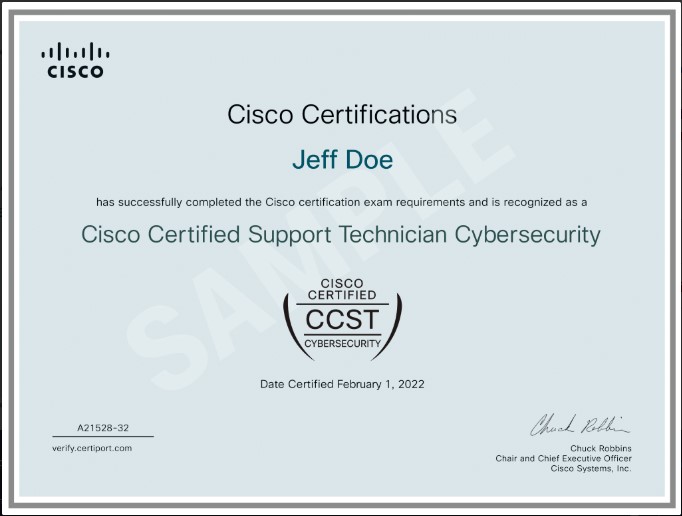
*Indicate reference only
Our pricing plans
At Kamakrit Consultancy, we’re committed to delivering world-class certification programs at an affordable price. Our flexible subscription models are designed to suit your goals and timeline, allowing you to select the best plan for your needs.
Minor transaction fees apply to all transactions.
Whats Included in Subscription?
Click here for dropdown
With each subscription plan, you’ll have access to comprehensive resources and support to ensure your success:
Complete Course Access
- Structured Learning Modules: Progress through step-by-step lessons via our e-learning platform, created by industry experts to provide in-depth knowledge and practical insights.
- Interactive Exercises & Case Studies: Apply what you’ve learned with hands-on exercises and real-world case studies designed to reinforce your skills.
- Supplementary Resources: Get access to downloadable PDFs, templates, and guides to deepen your understanding and support your learning journey.
Mock Tests
- Take advantage of practice exams that simulate the actual certification test environment, helping you feel prepared and confident on exam day.
Monthly / Weekly Follow-Up Monitoring
- Regular check-ins to track your progress, answer questions, and keep you motivated to reach your certification goals.
Certification & Assessment
Digital Badge: Receive a digital badge to proudly display on LinkedIn and other professional platforms, showcasing your achievements to employers and peers.Online Exams & Assessments: Measure your knowledge through quizzes and exams that verify your grasp of key concepts.Certification on Completion: Earn a globally recognized certification upon successful course completion.